Before the Stopwatch: How Runners Made Time Part of the Record
Explore how runners used time to describe an effort, what a clock can and cannot record, and how to keep a personal running log clear and useful.
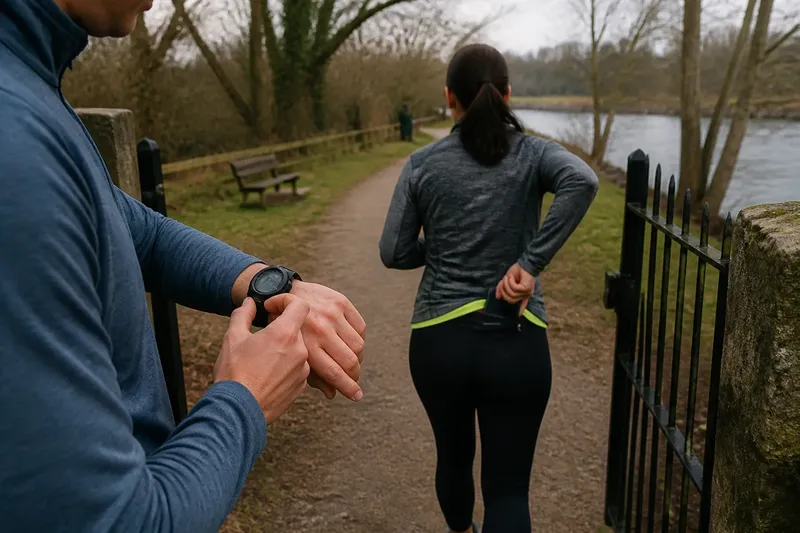
At a park gate, one runner starts a watch while a friend tucks a phone away and heads down the path. The difference is more than equipment: each is making a different kind of record. The history of running time is not a single story of clocks taking over. It is a record of how runners have used time alongside contests, training, company, and personal memory.
Looking at that history helps explain what a timed result can tell you—and what it cannot. A clock can make an effort easier to describe, but the meaning of the number depends on the task and the rules attached to it.
What does a running time record?
A running time records elapsed duration: the time between a chosen start and finish. In a race, those points are usually defined by the event. In a personal run, the runner decides where the effort begins and ends.
That makes time useful for comparing efforts, provided the tasks are similar enough. But a clock does not record every relevant detail. It cannot say whether a runner paused to wait for a companion, chose a slower pace to enjoy a riverside path, or was returning after time away.
Running has served many purposes, including competition, training, transport, recreation, and social ritual. A timed result describes one feature of an outing; it does not explain the whole reason for running.
Before starting a watch, decide what question you want the time to answer.
How did runners use clocks to describe an effort?
Runners can compare efforts in several ways: by who finishes first, by distance covered, by elapsed time on a set course, or by how an effort feels. Timing is especially useful when people share a start and finish or when a runner wants to track a defined task.
Personal timing depends on access to a clock or watch and on the runner’s own method. A runner might use a timepiece to record a familiar course, or simply note the duration afterward. These practices vary by place, period, and purpose; there is no single path by which timing became part of running culture.
Whatever the tool, a result depends on choices. Does the clock continue during a pause? Is the goal to finish quickly, maintain a steady effort, or complete a distance? A time is a reading attached to those rules, not a complete account on its own.
For a useful comparison, write down the task and any rule that affects the clock.
What should a runner record alongside time?
A brief note can make a time easier to interpret later. Use a notebook, a calendar, or a phone note. Record only the details that help explain the outing.
- Purpose: If the run was a planned timed effort, record that aim; if it was social or exploratory, note that instead so you do not compare unlike outings.
- Route: If you followed the same course, mark it as the usual route; if a detour or surface change altered it, describe the change and avoid treating the time as a direct comparison.
- Pauses: If the clock continued during a stop, say so; if you paused the clock, record that rule so the duration is not mistaken for uninterrupted elapsed time.
- Effort: If the run felt relaxed, steady, or demanding, write the word that fits; if you cannot recall, leave the note blank rather than guess.
- Company: If you ran with someone at a different pace or stopped to wait, note it; if you ran alone without interruptions, no company detail is needed.
- Context: If you were returning after a break or trying a new routine, add that detail; if nothing notable affected the outing, keep the record simple.
Imagine a runner, Sam, returning to a riverside path after time away. Sam writes “riverside path; comfortable effort; stopped to greet a neighbor” in a notebook and leaves the watch in a pocket. The record does not supply a time, but it does identify the route, the effort, and the pause. If Sam later times a similar run, that note can help explain why the outings are not directly comparable.
Keep the note brief enough that you will recognize the run when you read it later.
When is a stopwatch useful?
A stopwatch is useful when elapsed duration is the information you need. It can mark the length of a planned effort or help you repeat a session with the same start-and-stop rules. A regular watch can do the same job if it shows the time clearly.
A stopwatch differs from pace features on a sports watch or phone app. It records elapsed time. Pace features estimate speed over distance, while an app may also save a route or other details. Each tool answers a different question, and extra displays can add distractions.
If you want to focus on conversation, surroundings, or a relaxed effort, you can leave the display off. That is not a rejection of timing; it is a choice not to collect information that does not serve that outing.
Use a clock when you have a clear reason to want its answer.
What questions do runners ask about timing?
Can a runner train without a watch?
Yes. A runner can practice a regular routine, comfortable effort, or a planned distance without wearing a watch. Timing is one way to observe a run, not a requirement for purposeful training.
Does a personal running time need a fixed course?
A consistent course makes comparisons easier because the start and finish are less likely to change. If you use different routes, record them so the results are not treated as directly comparable.
Should a clock keep running during a pause?
Either method can be useful, but choose a rule before the run and record it. Continuing the clock records total elapsed time; pausing it records time spent moving under your chosen method.
What is the simplest running log?
Write the date, route or purpose, and one short note about effort or conditions. Add a time when it answers a question you care about, and identify any pause or timing rule that affects the result.
How can runners compare times fairly?
Start by checking whether the efforts share a purpose, course, and timing rule. If one run includes a long stop and the other does not, or the route has changed, the clock is describing different tasks.
Say a runner has two notes for the same park loop. The first says “steady effort, clock ran through a pause to retie a shoe.” The second says “steady effort, no pause.” The runner should keep both recorded times as descriptions of those outings, but avoid treating the difference as a clean comparison of running pace. The pause is a concrete reason the results may not line up.
The main search phrase, running time history, points to a useful distinction: timekeeping can make an effort legible, while the rules and context explain what the record means. Keep those details with the clock reading, and the number is less likely to be mistaken for the whole run.