Your First Group Run: A Few Things to Settle Before You Meet
Plan your first group run with a clear meeting point, an honest pace check, and a simple way to handle route changes without adding pressure.
You reach the library steps a few minutes before your first group run, but the message says only “meet by the park.” Two runners are already setting off, and a third is looking toward the street. A small plan made before leaving home can turn that uncertain moment into an easy hello. For a first group run, settle the meeting point, intended pace, and route-change plan with the organizer before you go.
How can you make the meeting point unmistakable?
“The park” may mean a gate, a fountain, a parking lot, or the first trail junction. Ask for a landmark that is easy to identify from the sidewalk, then confirm which side or entrance the group will use. A place such as the north entrance beside the bus shelter is more useful than a broad neighborhood name.
Also ask how the group identifies itself. Some organizers wear a bright club shirt; others carry a small sign or wait near a particular bench. You do not need to search for a formal uniform. The goal is simply to know whom to approach without guessing.
Check the practical details that could affect your arrival: whether the group leaves promptly, whether there is a nearby place to lock a bike, and whether the meeting spot is accessible from the route you will take to get there. If you expect to be late, ask whether someone can wait or whether you should meet the group at a named point along the route. Avoid assuming that runners will notice a message while they are moving.
Keep the organizer’s contact information handy, and send a short confirmation if the directions still feel vague. “I’ll wait at the north entrance by the shelter” gives both of you a clear reference.
What pace should you expect?
A pace description can mean different things to different runners. “Easy” might refer to a relaxed effort, a conversational rhythm, or a particular pace range. For your first outing, ask how the group describes its pace and whether it stays together or separates into smaller groups.
Think about effort rather than trying to match a number you have not discussed. A conversational pace generally means you can speak in short, comfortable sentences while running. Hills, weather, and crowding can change how that feels, so a pace label is a starting point rather than a promise that every stretch will feel identical.
It is reasonable to tell the organizer what you are comfortable with and ask whether the run suits that level. You might say, “I’m new to group runs and prefer an easy pace. Does anyone stay with that group?” That gives the organizer a chance to explain the arrangement without asking you to prove anything.
Clarify what happens if runners spread out. Does the group pause at crossings, regroup at a trail junction, or let runners choose a pace group? A relaxed run can still feel stressful if you do not know whether falling behind means you have missed a turn or simply have more room to run.
What happens if the route changes?
Group routes sometimes shift because a path is closed, a crossing is busy, or the organizer decides that a section is unsuitable. Before the run, ask how changes are announced and what landmarks the group uses to regroup. You do not need a full route briefing; you do need to know how to recognize the planned adjustment and how to avoid being left with no clear direction.
Ask whether the organizer can share a route map or a short written description. If you use a phone, save the route before setting off and check that you can access it without relying on a strong signal. A map is a backup, not a substitute for listening to the organizer at turns.
For a first run, it also helps to agree on a simple fallback: if you lose the group, stop somewhere safe and contact the organizer rather than guessing which path to take. Choose a familiar, public place for a possible regrouping point if the group has one. Do not assume that every runner has the same app, device, or route file.
Where a route passes through a place with posted access rules, follow the signs and the organizer’s guidance. Local conditions and access instructions can differ, so treat the route as a shared plan rather than a private shortcut.
How does a low-pressure first run unfold?
Imagine Maya, who has run alone on neighborhood sidewalks but has never joined a club. She sees an invitation for an easy Saturday morning run at a riverside park. The announcement says “meet at the boathouse,” gives a conversational pace, and mentions a loop near the water, but it does not explain what happens if the path is crowded.
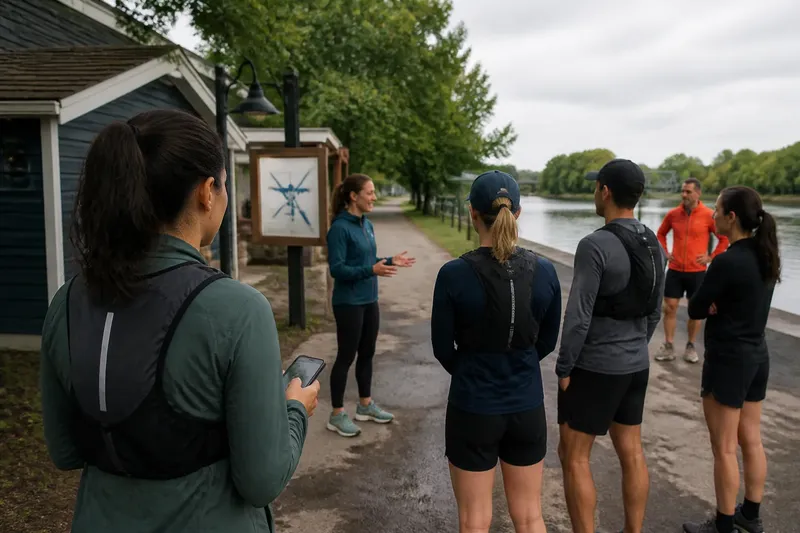
Maya sends the organizer a note asking which entrance to use, whether the group waits for late arrivals, and how it handles a blocked path. The organizer replies that everyone should gather at the west entrance beside the boathouse sign, that the group leaves after a brief welcome, and that runners regroup at a marked junction if they take a detour. The pace group stays together at crossings, with no expectation that newcomers keep up with faster runners.
Before leaving, Maya saves the route map and checks the park’s access notice. She brings a phone and a small amount of water, then gives herself enough time to find the entrance without rushing. At the meeting point, she introduces herself and repeats the plan in her own words: west entrance, easy group, regroup at the junction if the route changes.
During the run, a crowded stretch prompts the organizer to redirect the group along a parallel path. Maya hears the change, follows the runners ahead, and recognizes the junction where the group pauses. She finishes having met the people she came to meet, while learning that a detour is easier to handle when the regrouping point is clear. The result is not a perfect run; it is a first outing with fewer unanswered questions.
What should you ask before your first group run?
Can I join if I might need to slow down?
Ask whether the group has a conversational pace or a separate option for runners who want to take it easy. An organizer can explain the group’s usual approach, so you can decide whether it feels suitable before arriving.
Should I bring a route map?
A saved map or written route can help you understand the plan if the group changes direction or you become separated. Ask whether the organizer shares one, and keep in mind that you may still need to follow local signs and on-the-spot directions.
What if I arrive after the group leaves?
Ask in advance whether the group has a late-arrival plan or whether you should skip that outing if you miss the start. Do not set off alone to catch up unless the organizer has given you a clear, suitable meeting point.
Do I need to introduce myself to everyone?
A brief hello to the organizer is enough to start. You can mention that it is your first group run and ask whom to follow; there is no need to make a speech or explain your running history.
How can you keep the plan simple?
Before the run, make sure you can answer three questions without scrolling through a long message thread:
- Where exactly do we meet? Confirm the entrance or landmark and the side of the street or park.
- What pace should I expect? Ask how the group defines its pace and what happens if runners spread out.
- How will I know about a change? Learn how the organizer calls a detour and where the group regroups.
- What if I am late or separated? Know whom to contact and whether there is a designated fallback point.
- What should I bring? Follow the organizer’s note, and carry only what suits the route and conditions.
These questions are not a test of the group. They help you arrive with a shared understanding, and they give the organizer a chance to make the invitation clearer for the next newcomer.
A first group run can stay low-pressure when the practical details are settled before the shoes are on. Keep the message with the meeting point and contact name accessible, then arrive ready to listen and adjust. If you later invite someone else, share the same small details plainly: where to stand, what pace to expect, and where to regroup if the route changes.